


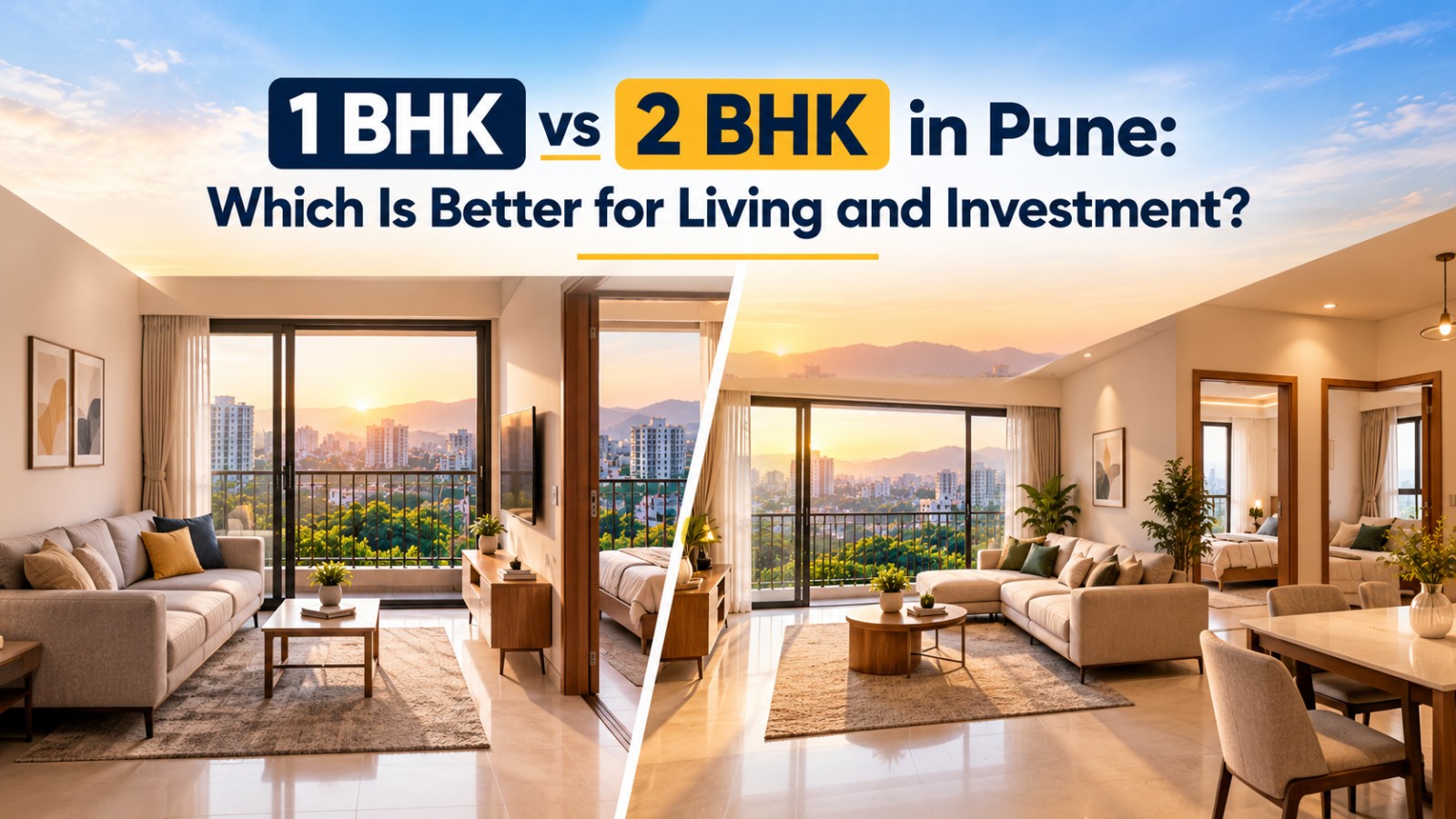
Buying a flat in Pune is an important decision, whether you are a first-time homebuyer, a young professional, a couple planning for the future, or an investor looking for rental income. One of the first questions you may face is whether to choose a 1 BHK or a 2 BHK apartment. Both configurations have advantages, but the right choice depends on your budget, lifestyle, space requirements, and long-term financial goals.
When comparing 1 BHK vs 2 BHK in Pune, consider more than the purchase price. Monthly expenses, location, connectivity, rental demand, resale potential, and future family needs can all influence your decision. Reviewing practical Homebuyer Tips can also help you understand what to evaluate beyond the apartment’s size and advertised price.
Let’s compare 1 BHK and 2 BHK flats in Pune to help you decide which configuration is better suited to your needs.
Understanding the Difference Between 1 BHK and 2 BHK Flats
A 1 BHK apartment generally includes one bedroom, a hall or living area, and a kitchen. It may also include one or more bathrooms and a balcony, depending on the design.
A 2 BHK apartment typically includes two bedrooms, a hall or living area, and a kitchen, with bathrooms and balconies varying by project.
The main difference is the additional bedroom in a 2 BHK flat. This extra space can serve several purposes, such as accommodating children, hosting guests, creating a home office, or providing privacy for family members.
A 1 BHK may be sufficient for someone who lives alone or a couple with limited space requirements. A 2 BHK may be more suitable for households that need flexibility or expect their living arrangements to change.
However, apartment configurations alone do not determine usability. Compare the actual carpet area, room dimensions, ventilation, storage, and layout before making a choice.
Purchase Price and Affordability
The purchase price is often the biggest factor when choosing between a 1 BHK and a 2 BHK flat.
Why consider a 1 BHK?
A 1 BHK generally has a lower total purchase price than a comparable 2 BHK in the same project. This can make it an attractive option for first-time buyers who want to enter the property market without stretching their finances.
A lower purchase price may also mean a smaller home-loan requirement and a more manageable down payment, depending on the buyer’s eligibility and financing arrangements.
Why consider a 2 BHK?
A 2 BHK usually requires a larger initial investment, but it offers an additional bedroom and potentially greater flexibility over time.
For buyers who expect to stay in the property for several years, the additional space may justify the higher cost. However, affordability should be assessed against income, existing obligations, savings, and future expenses.
Before deciding, compare the total purchase cost, including stamp duty, registration, parking, maintenance deposits, interiors, and applicable taxes. A property that appears affordable based on its advertised price may involve additional costs that affect your budget.
The better option is the one you can comfortably afford without compromising your financial stability.
Space and Everyday Comfort
The amount of space you need depends on how you use your home.
A 1 BHK can provide comfortable living for a single person or a couple who prefers a compact, easier-to-manage apartment. It may be suitable for people who spend much of their day at work and need a practical place to relax.
A 2 BHK provides an additional room that can improve flexibility. It may serve as a children’s bedroom, guest room, home office, study area, or storage space.
For couples who work remotely, the extra bedroom can help separate work and personal activities. Families may appreciate having more privacy as children grow older.
When evaluating Future Home Needs, think about how your household may change over the next five to ten years. Consider whether you might need a dedicated workspace, additional storage, or a separate bedroom for a family member.
The goal is to select a configuration that meets your current requirements while remaining practical for your expected lifestyle.
Maintenance Costs and Monthly Expenses
Owning a flat involves recurring expenses in addition to the home-loan EMI.
A 1 BHK may have lower overall ownership costs because its smaller size can mean fewer furnishings, lower interior expenses, and potentially lower maintenance charges where these are calculated according to area or another size-related basis.
A 2 BHK may require more furniture, lighting, storage, and interior work. Depending on the project, maintenance charges may also be higher.
However, not every expense depends on apartment size. Some housing societies charge common maintenance fees according to a fixed formula, while utilities depend on actual consumption and applicable billing arrangements.
Before purchasing either configuration, ask for an estimate of monthly maintenance, property tax, utility expenses, insurance where applicable, and likely repair costs.
Investors should also account for vacancy periods and expenses between tenants. Comparing the full cost of ownership provides a more realistic picture than looking at the EMI alone.
Which Is Better for Investment and Rental Income?
Both 1 BHK and 2 BHK flats can be investment options, but their suitability depends on the location, purchase price, target tenants, and local rental demand.
1 BHK flats in Pune
A 1 BHK may appeal to students, single professionals, and some couples seeking relatively affordable accommodation. In locations close to employment hubs, educational institutions, or public transport, a compact apartment may attract tenants looking for a smaller living space.
The investment case depends on the price paid and the rent achievable. A lower purchase price does not automatically guarantee a higher rental yield.
2 BHK flats in Pune
A 2 BHK may appeal to couples, small families, professionals sharing accommodation, and tenants who need an additional room for work or guests.
Depending on the neighbourhood, a larger apartment may attract a broader range of households. However, it also requires a higher investment, and its rental return may or may not be proportionately higher.
To compare investment potential, calculate the gross rental yield:
Gross rental yield = (Annual rental income ÷ Total property purchase cost) × 100
For example, if a property costs ₹50 lakh and generates ₹20,000 in monthly rent, its annual rental income is ₹2.4 lakh and its gross rental yield is 4.8%.
This calculation excludes maintenance, property tax, vacancy, repairs, financing costs, and other expenses. Compare realistic local rents and similar properties before investing.
Resale Potential and Long-Term Flexibility
Resale demand depends on several factors, including location, property condition, connectivity, pricing, building quality, and the availability of comparable apartments.
A 1 BHK may appeal to buyers looking for a smaller entry-level property or an apartment with a relatively lower total purchase price. A 2 BHK may attract buyers who need more space for their household or prefer an additional room for future use.
Neither configuration guarantees better appreciation or faster resale. A well-located, sensibly priced 1 BHK may be more attractive than an overpriced 2 BHK, while a practical 2 BHK may appeal to a wider set of households in a family-oriented neighbourhood.
Look at the property’s actual location, nearby employment opportunities, transport access, social infrastructure, and competing supply.
If investment is your priority, consider both rental yield and potential resale demand rather than assuming that a larger flat will necessarily produce higher returns.
Location and Amenities Matter as Much as Configuration
Even a well-designed apartment may not be the right choice if its location does not suit your everyday routine.
Before selecting a flat, evaluate commuting distances, access to schools and healthcare, shopping facilities, public transport, road connectivity, and the neighbourhood’s overall suitability.
The importance of each factor will vary by buyer. A working professional may prioritise access to an office, while a family may value schools, outdoor spaces, and healthcare facilities.
Amenities also influence the residential experience. Parking, security arrangements, lifts, recreational areas, and landscaped spaces may be useful, but they should be assessed alongside maintenance costs and actual availability.
When comparing 1 & 2 BHK Flats, review the available configurations, carpet areas, specifications, and project details rather than choosing based solely on the number of bedrooms.
For buyers considering West Pune, 2 BHK Flats in Pashan may be worth evaluating against their budget, commuting needs, and space requirements. Verify current availability, pricing, approvals, and possession details directly with the developer.
1 BHK vs 2 BHK in Pune: Quick Comparison
| Factor | 1 BHK | 2 BHK |
|---|---|---|
| Purchase price | Generally lower | Generally higher |
| Space | Suitable for compact living | More room and flexibility |
| Household suitability | Singles and some couples | Couples, small families and shared households |
| Interior expenses | Usually lower | Usually higher |
| Rental audience | Singles, students and some couples | Families, couples and some shared households |
| Home-office flexibility | Limited | Additional room can serve as a workspace |
| Investment outcome | Depends on price and rental demand | Depends on price and rental demand |
Conclusion: Which Flat Should You Choose?
When comparing 1 BHK vs 2 BHK in Pune, the right choice depends on your budget, household size, lifestyle, and long-term plans.
A 1 BHK may be suitable if you want a lower initial purchase cost, compact living, and manageable household expenses. A 2 BHK may be the better fit if you need additional space, expect your family to grow, or want greater flexibility for work and everyday activities.
For investors, the decision should be based on realistic rental demand, total acquisition costs, expected expenses, and potential resale demand. Neither configuration guarantees better returns.
Before booking, compare the carpet area, location, project approvals, construction quality, maintenance charges, and total cost of ownership. If you are considering a 2 BHK home in West Pune, review the available details for Sai Shriya Ankur and assess whether its location and configuration fit your requirements.
A careful comparison will help you choose a flat that works for your present needs while supporting your future goals.
Frequently Asked Questions (FAQs)
Q1. Is a 1 BHK or 2 BHK better for first-time homebuyers?
A 1 BHK may suit buyers with a tighter budget or smaller space requirements. A 2 BHK may be more appropriate if you need an additional room and can comfortably manage the higher purchase and ownership costs.
Q2. Which flat is better for rental income in Pune?
Both configurations can attract tenants. The better investment depends on local rental demand, the purchase price, vacancy risk, maintenance expenses, and the rent achievable for a comparable property.
Q3. Is a 2 BHK flat a better long-term choice?
A 2 BHK offers more flexibility for changing household needs, but whether it is the better choice depends on affordability, expected length of stay, and the usefulness of the extra room.
Q4. How do I compare 1 BHK and 2 BHK investment returns?
Calculate gross rental yield using annual rent divided by the total purchase cost. Then account for maintenance, repairs, taxes, vacancy, financing, and other expenses to estimate the investment’s net return.
Q5. What should I check before buying a flat in Pune?
Review the total price, carpet area, location, connectivity, project approvals, developer track record, possession timeline, maintenance costs, and suitability for your household or investment goals.